Implants...
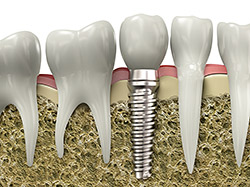
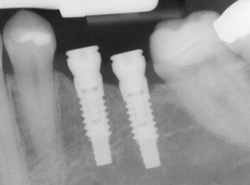
Dental Implants are titanium fixtures that replace the root of your teeth and are stronger and more durable than traditional bridges and dentures. Implants offer a permanent solution to tooth loss while providing artificial teeth that look natural and feel secure.
Today's dental implants are virtually indistinguishable from other teeth.

Additionally, implants may be used in conjunction with other restorative procedures for maximum effectiveness. For example, a single implant can serve to support a crown replacing a single missing tooth or Implants can also be used to support a dental bridge for the replacement of multiple missing teeth as well as be used with dentures to increase stability and reduce gum tissue irritation.
Dental implants can be your doorway to renewed self-confidence and peace of mind. Implants help preserve facial structure, preventing bone deterioration that occurs when teeth are missing.
WHO’S A CANDIDATE
A good candidate is anyone missing one or more teeth, or who is unhappy with their dentures. Age is not a factor. However, smoking, diseases such as diabetes and radiation therapy to the area have been shown to lower the success rate of implant placement.
THE IMPLANT PROCEDURE
Implants are typically placed in a single sitting but require a period of Osseo integration. Osseo integration is the process by which direct anchorage of a dental implant root and the bone of the jaw occur. An Osseo integrated implant takes anywhere from three to six months to anchor and heal. The length of time varies from person to person, depending upon the quality and quantity of bone. The majority of dental implants and bone grafts can be performed in the office under local anesthesia.
After the healing has occurred, Dr. Salhi will take an impression for the restorative phase of your treatment.


The restoration will be complete by fitting the crown to the dental implant
DO I HAVE ENOUGH BONE?
When the walls of your socket are very thin, a bone graft is often placed at the time of tooth extraction to help your body fill in the empty socket with bone. This step will maintain the width and volume of bone you will need for implant placement several months later.
WHAT CAN I USE FOR TEETH WHILE THE IMPLANT/S HEAL?
Many options are available and they are tailored to your specific requirements. If you need a replacement tooth while the implants are healing, temporary removable teeth or a temporary bridge can be made. If all of your teeth are missing, we can usually modify your present complete denture or make you a new temporary denture. Temporary teeth may be made and inserted the same day. Depending on your particular situation, some implants can be placed and “loaded” immediately.
SUCCESS RATES OF DENTAL IMPLANTS
Dental implants are among the most successful procedures in dentistry. There is no guarantee that an implant procedure will be successful, but studies have shown a five-year success rate of 95% for lower jaw implants and 90% for upper jaw implants. The success rate for upper jaw implants is slightly lower because the upper jaw (especially the posterior section) is less dense than the lower jaw, making successful implantation and osseointegration potentially more difficult to achieve. Lower posterior implantation has the highest success rate for all dental implants.
While dental implants may fail for a number of reasons, the cause is often related to a failure in the osseointegration process. For example, if you are a smoker who is considering a dental implant, Dr. Salhi will likely advise you to give up smoking before undergoing the process. Smokers face a higher risk of implant failure.
WHAT ARE THE POTENTIAL PROBLEMS?
Although it is natural to be concerned about the pain that may be caused by these procedures, most patients do not experience severe or significant post-operative pain. If needed, pain medication and antibiotics will be prescribed for you to make your recovery as easy as possible.
Even though great care is taken to place the implant precisely, occasionally adjacent teeth are injured in the placement process. In addition, there is a chance that the nerve in the lower jaw, which provides sensation to your lower lip and chin, may be affected. If you are missing quite a lot of bone, it might be difficult to place an implant without infringing on the nerve space. Although we take great care to avoid this nerve, occasionally it is irritated during the procedure, resulting in tingling, numbness or a complete lack of sensation in your lip, chin or tongue. Usually these altered sensations will resolve within time, but they can be permanent and/or painful. If you notify us of post-operative numbness as soon as possible, it will allow us to manage your care in the most appropriate way.
HOW LONG WILL THE IMPLANTS LAST?
When patients are missing all of their teeth, long-term studies (more than 30 years) show an 80% to 90% success rate. For patients missing one or several teeth, recent studies show a success rate of greater than 95%, which compares favorably with other areas in the body that receive implant replacement (such as hips or knees). However, if one of your dental implants either doesn’t heal properly or loosens after a period of time, you may need to have it removed. After the site heals (or on occasion at the time of removal), another implant usually can be placed.
Once the implants are in place, they will serve you well for many years if you take care of them and keep your mouth healthy. This means taking the time for good oral hygiene (brushing and flossing) and keeping regular appointments with your dental specialists.